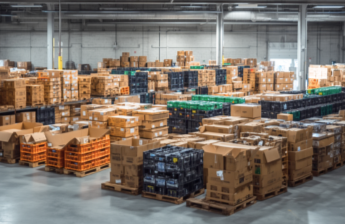
However, warehousing is not simply a matter of having floor space. An efficient logistics operation must coordinate the receipt, identification, handling, preparation, packing, loading and dispatch of each item. For this reason, companies requiring industrial goods storage in Barcelona must assess both the facilities and the technical capabilities of the logistics operator.
The importance of warehousing within an export operation
In industrial exports, the warehouse acts as a link between the factory, the packaging process and international transport.
When these stages are not co-ordinated, delays, unnecessary movements, errors in order preparation or damage during handling can occur. It can also increase the amount of time goods take up space within the production plant.
A specialised, comprehensive warehousing and logistics service enables goods to be received, kept safe and prepared for subsequent loading and transport, all within a single operational environment.
This centralisation is particularly useful when:
- The date of manufacture does not coincide with the date of dispatch.
- Components from different suppliers need to be brought together.
- The goods require special packaging before being exported.
- Heavy or oversized machinery is involved.
- There are production peaks or a lack of space at the plant.
- The shipment has to wait for documentation, transport or port availability.
- Orders with different product codes or units need to be prepared.
What should a logistics warehouse for exports offer?
Not all warehouses are equipped to handle industrial goods. Capital goods, machinery and technical components require suitable facilities, specialist staff and procedures tailored to their specific characteristics.
Capacity to receive industrial goods
The operator must be able to handle heavy, bulky, fragile or high-value loads. This requires loading bays, lifting equipment, manoeuvring areas and suitable technical resources.
Before storing goods, it is also advisable to analyse their weight, dimensions, points of support and storage requirements. This information helps to determine where to place them and what equipment to use when handling them.
Distinct areas and spatial organisation
A well-organised warehouse layout prevents unnecessary movement and reduces the risk of errors. Goods can be categorised, for example, according to their status:
- Awaiting packing.
- Packed and ready for dispatch.
- In transit.
- Awaiting documentation.
- Awaiting completion with other items.
- Ready for loading into a container.
Control and identification of goods
Each item in storage must be correctly identified. In complex industrial projects, it may be necessary to keep track of serial numbers, part numbers, weights, dimensions, orders, destinations or special handling instructions.
Clear identification reduces errors in load preparation and enables checks to be carried out to ensure that all components are available before a consignment is finalised.
Flexibility in storage times
International operations may be subject to changes in dates due to transport availability, documentation procedures or coordination with the end customer.
For this reason, warehousing must be adaptable to different needs: from a short-term hold prior to loading a lorry to longer-term temporary storage whilst a project is being completed.
How to optimise industrial stock prior to export
Stock optimisation begins before the goods arrive at the warehouse. Proper planning helps to reduce costs, avoid repeated handling and improve on-time delivery.
1. Classify goods according to their characteristics
Not all industrial goods can be handled in the same way. It is advisable to classify them taking into account factors such as:
- Weight and dimensions.
- Fragility.
- Economic value.
- Sensitivity to moisture or corrosion.
- Need for heat treatment.
- Type of transport.
- Country of destination.
- Expected dispatch date.
2. Set priorities for incoming and outgoing items
Goods should not simply be placed wherever there is free space. It is also important to consider when they will be dispatched and what operations are required before they leave.
Products that need to be loaded first must remain accessible. Conversely, goods that will remain in storage for longer can be placed in areas further away from the loading bays.
Proper planning reduces internal movements and avoids having to move several loads just to access a single one.
3. Coordinate storage with industrial packaging
Packaging must be designed taking into account the type of goods, the mode of transport and the conditions they will encounter during the journey.
Integrating warehousing with a bespoke industrial packaging service enables each consignment to be prepared as part of a single operation. This avoids additional movements and reduces the risk of damage during intermediate handling.
Depending on the project, it may be necessary to use wooden crates, reinforced cardboard packaging, anti-corrosion materials, internal protective padding, shrink-wrap or hybrid solutions.
4. Integrate picking and packing
Industrial exports do not always consist of a single machine or part. In many cases, they include sets of components, spare parts, accessories or kits that must arrive at their destination in an organised manner.
The industrial picking and packing service enables the relevant items to be selected, grouped and packed in accordance with the specifications of each order.
This stage is particularly important in order to avoid:
- Incorrect part numbers.
- Incomplete orders.
- Components sent to the wrong destination.
- Damage caused by inadequate packaging.
- Delays on the customer’s assembly lines.
5. Consolidate logistics operations
One of the most effective ways to optimise industrial stock is to reduce the number of suppliers involved in the operation.
When storage, packaging, order fulfilment and loading are carried out separately, the number of transfers and handling points increases.
Working with a single logistics partner facilitates coordination and enables a seamless process:
Receipt → identification → storage → preparation → packing → loading → dispatch.
This integration improves time management and reduces the likelihood of incidents.
6. Prepare the load correctly for transport
Even goods that have been properly stored and packed can still be damaged if they are not correctly secured during transport.
Securing goods in containers allows the load to be fixed in place to prevent shifting, impact or overturning during the journey. Depending on the weight and nature of the product, wooden structures, lashing straps, strapping bands, airbags, chains or steel cables may be used.
This stage is particularly important in maritime transport, where goods may be exposed to continuous movement over long periods.
7. Measure the results of the operation
To improve stock management, it is advisable to analyse a number of key indicators:
- Average time spent in the warehouse.
- Number of internal movements per item.
- Occupancy rate.
- Time required to prepare each dispatch.
- Incidents during picking.
- Damage caused during handling.
- Compliance with dispatch dates.
- Logistics cost per project or order.
Benefits of outsourcing the storage of industrial goods in Barcelona
Outsourcing warehousing can bring significant benefits to manufacturing firms, engineering firms, automotive companies and capital goods suppliers.
Freeing up production space
Using the factory as a warehouse limits the space available for production, assembly or receiving new materials. Moving finished goods to a logistics centre helps to keep the premises operational and tidy.
Reduction in investment
The company does not need to expand its premises or invest in cranes, forklift trucks, loading bays or specialist equipment for one-off operations.
Greater flexibility
The volume of goods can vary depending on projects, campaigns or production schedules. An external operator allows space and resources to be tailored to each specific need.
Specialised handling
Industrial goods require procedures that differ from those used in conventional logistics. Staff must know how to move, lift, protect and secure heavy or oversized loads.
Better coordination of exports
Centralising goods makes it easier to prepare them for transport by sea, land or air. It also makes it possible to organise complete shipments when the items come from different factories or suppliers.
Lower risk of damage
Reducing transfers between facilities minimises the number of handling points. If storage, packaging and loading all take place at the same site, the goods remain within a controlled operational environment.
Barcelona as a strategic location for industrial logistics
Barcelona is home to significant industrial activity and boasts land, sea and air links that facilitate national and international distribution.
For an exporting company, having a warehouse close to the main industrial corridors and the Port of Barcelona can simplify the coordination of shipments and reduce transport distances.
Embalex has facilities in Santa Perpètua de Mogoda and a presence in the ZAL Prat, next to the Port of Barcelona. Its logistics centre in Santa Perpètua covers an area of 26,000 square metres, with six loading bays and eight cranes with a capacity of up to 70 tonnes.
The locations of its various centres can be found on the Grupo Embalex locations page.
Which goods are eligible for this service?
An export logistics warehouse can be used for numerous types of industrial products:
- Machinery and capital goods.
- Automotive components.
- Railway equipment.
- Aerospace parts.
- Electrical and energy equipment.
- Equipment for industrial facilities.
- Tools and moulds.
- Metal structures.
- Production line components.
- Heavy or oversized goods.
- Orders with multiple items.
- Cargo awaiting packing or dispatch.
A comprehensive solution for optimising industrial stock
Optimising stock intended for export is not simply a matter of finding available space. It is necessary to organise the goods, minimise handling, plan outbound shipments and coordinate storage with packaging and transport.
Having a specialised logistics warehouse for exports frees up production space, improves the security of loads and simplifies the preparation of international shipments.
Embalex offers a comprehensive solution for receiving, storing, preparing, packing and getting goods ready for dispatch. Companies looking to explore a storage project for industrial goods in Barcelona can contact the Embalex team to request a solution tailored to the type of cargo, volume and destination.
________________________________________________________________________________________
Frequently asked questions about industrial warehousing for export
What does an export storage and logistics service include?
It may include the receipt of goods, unloading, identification, temporary storage, order fulfilment, industrial packaging, cargo consolidation, container loading, lashing and coordination of the shipment.
Can storage be arranged for just a few days?
Yes. Temporary storage is common when there is a gap between the end of production and the scheduled transport date.
Can heavy or bulky goods be stored?
Yes, provided the facility has the appropriate lifting equipment, manoeuvring areas and handling equipment for their weight and dimensions.
Is it possible to store goods that have not yet been packed?
Yes. Goods can be received unpacked and prepared at a later stage, depending on the destination, the mode of transport and the project requirements.
What is the difference between warehousing and picking?
Warehousing involves storing and organising goods within a facility. Picking involves selecting the items or SKUs required to fulfil a specific order.
Why is it important to integrate packaging with warehousing?
Because it avoids intermediate transport, reduces the number of handling operations and allows goods to be prepared for export within a single operational environment.
How to choose a logistics warehouse for exports?
It is advisable to assess the capacity of the facilities, the handling equipment, experience with industrial cargo, the ability to integrate packaging and order picking, proximity to dispatch points, and the ability to adapt to each project.