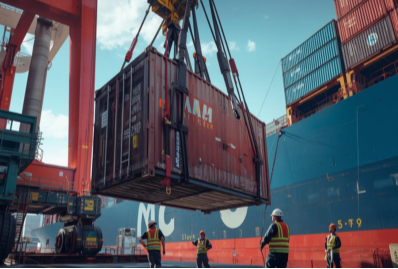
What is container cargo lashing?
The lashing of goods in containers involves designing and implementing a lashing and securing system tailored to the type of goods, their weight, centre of gravity, dimensions and the type of transport unit used. Not all loads require the same solution: industrial machinery, metal structures, fragile goods or indivisible loads all require different securing systems.
In practice, lashing may incorporate materials such as timber, lashing straps, strapping, airbags, polyester webbing, steel cables or chains, depending on the load each securing point must bear. It may also be supplemented with special skids, support elements, physical and chemical protection or anti-corrosion solutions when the route and type of goods so require. Embalex applies precisely this comprehensive approach to its container lashing and loading services.
Why it is essential to secure cargo properly on board ships
Securing cargo on board ships is critical because the sea exerts constant dynamic forces on the goods. The IMO explains that many securing problems arise from the accelerations caused by the ship’s longitudinal, vertical and, above all, transverse movements. If the cargo is not correctly stowed and secured, it can shift, break the packaging, strike other units or compromise operational safety.
In addition to the physical risk, poor securing often results in avoidable costs: claims, returns, additional handling costs, delays and damage to the exporting company’s reputation. In the case of industrial goods or high-value equipment, a failure in lashing can affect sensitive components, finishes, internal fixings or parts exposed to corrosion and moisture. For this reason, lashing must not be separated from technical packaging or environmental protection.
Factors to consider before securing the load
Before deciding on a lashing system, it is advisable to consider several technical aspects of the load. The first is the total weight and its distribution within the container. The second is the centre of gravity, which is particularly important for machinery, capital goods and bulky parts. The third is the strength of the packaging itself and of the support or anchoring points. Effective lashing does not simply depend on tightening a strap: it depends on the entire solution being designed to withstand real-world stresses.
The type of container or support used must also be taken into account. Working with a standard box container is not the same as working with an Open Top, a Flat Rack or a special platform. Embalex, for example, provides lashing services for different container formats and for complex or indivisible loads, demonstrating that the choice of support directly determines the securing strategy.
Common lashing materials and systems in maritim e transport
Among the most commonly used systems for securing goods in containers are lashing straps, strapping bands, steel cables, chains, wooden blocks and transport airbags. Each serves a different purpose: some absorb tension, others fill gaps, others distribute the load, and others prevent movement between packages or against the walls of the transport unit.
Airbags, for example, exert pressure against the walls of the transport unit and help prevent the load from moving, adapting to any unevenness between packages. However, as with any securing system, their effectiveness depends on them being used in the correct position and as part of an overall securing strategy.
For more complex loads, it is common to use special wooden or steel cradles, structural reinforcements and bespoke solutions. This is particularly useful for machinery, capital goods or oversized loads, where simply ‘filling gaps’ is not enough; instead, engineering support, load distribution and secure fastening are required. Embalex mentions these types of solutions in its lashing and specialised cargo services.
Common mistakes when securing cargo in containers
One of the most common mistakes is to assume that the weight of the cargo is sufficient to keep it stable. In reality, a heavy load without longitudinal or lateral securing can shift violently during braking, manoeuvres or the movement of the vessel. The guidance documents associated with the CTU Code provide specific examples of loads that break through doors or shift due to inadequate securing.
Another common mistake is using the correct securing materials but without an appropriate overall design. A well-tensioned strap does not compensate for incorrect weight distribution, a poor base or packaging that lacks sufficient strength. It is also common to overlook environmental factors such as humidity or temperature changes, which in maritime transport can affect both the condition of the product and the behaviour of certain auxiliary materials.
The relationship between lashing, technical packaging and the protection of goods
In maritime shipping, securing a load involves more than just lashing it down. It requires a combination of technical packaging, impact protection, humidity control, anti-corrosion barriers and a lashing system tailored to the specific journey. This comprehensive approach is central to Embalex’s positioning, which combines industrial packaging, lashing, protection and sector-specific solutions for various industries.
This becomes even more important when goods are travelling long distances, undergo multiple handling operations, or must arrive in optimal condition at a demanding end customer. A professional solution reduces incidents and improves logistical reliability. In other words, good lashing not only protects the cargo: it also safeguards project delivery, deadlines and the company’s reputation.
When is it advisable to use a professional lashing service?
Outsourcing lashing is usually the best option when working with industrial machinery, heavy loads, fragile goods, long-haul sea freight, special containers or projects with high technical requirements. In these cases, operational expertise makes the difference between a standard solution and a truly secure securing system. Embalex stands out precisely for its simple and complex lashing services, loading of various types of containers, machinery movements and operations in port environments.
All of this ensures safety, traceability and more efficient execution, particularly in environments where coordination between packing, loading and transport must be highly precise.
___________________________________________________________________________________________
The lashing of goods in containers is a technical decision that directly affects safety, product integrity and the efficiency of maritime transport. Properly securing cargo on board ships requires analysing the goods, carefully selecting lashing m a t e r i a l s, adapting the solution to the type of container, and supplementing the securing process with appropriate packaging and protection.
If your company d e al s with exports, capital goods or sensitive cargo, having a professional lashing and packaging service can make the difference between a safe operation and a costly incident.
In this context, Embalex offers a particularly robust solution thanks to its expertise in industrial packaging, container loading and lashing for maritime transport.
Please contact Embalex for further information.