The importance of careful planning
The first step in relocating industrial plants is to draw up a detailed plan that takes into account:
- A comprehensive inventory of machinery and equipment.
- An assessment of the weight, size and fragility of each item.
- A review of local and international transport regulations.
- A schedule designed to minimise plant downtime.
Specialist packaging for heavy machinery
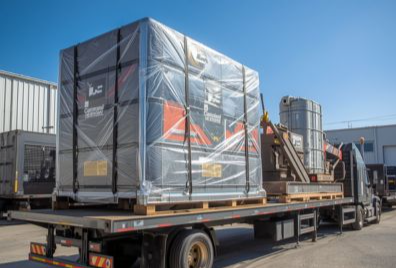
The international transport of heavy machinery requires specific packaging techniques:
Strategic dismantling: Breaking down large, heavy components to make them easier to transport.
Protection using high-strength materials: Use of timber, industrial foam, shrink wrap and other materials to prevent damage.
Marking and labelling: Clear identification of parts to speed up assembly on site.
Modular packaging: Allows items to be stacked or grouped securely during transport.
Safe and efficient transport
The transport of industrial machinery must be tailored to each type of equipment and destination. Here are some recommendations:
- Hire operators specialising in the international transport of heavy machinery.
- Selection of the appropriate mode of transport: sea, air or road, depending on dimensions and urgency.
- Use of cranes, forklifts and special platforms for loading and unloading.
- Securing the load to prevent movement during transit.
Comprehensive logistics coordination
A successful relocation of industrial plants requires coordination between:
- The company’s in-house team.
- Transport and logistics providers.
- Companies specialising in industrial packaging.
- Local and international authorities.
___________________________________________________________________________________________
The success of an industrial plant relocation depends on meticulous planning, specialist packing and the selection of suitable transport, and at Embalex we understand this. For international operations, it is crucial to work with experts in the international relocation of heavy machinery who can guarantee safety, efficiency and regulatory compliance. Planning every detail ensures that the plant can resume operations at its new destination quickly and without a hitch.
Please contact Embalex for further information.